Planning a commercial finish-out: keeping the electrical on schedule
When the doors have to open on a set day, the electrical schedule is the schedule.
October 6, 2026 · 4 min read
If you are running a business, every day the space sits unfinished is a day of rent with no income against it. Craine’s puts it plainly on its commercial page: time is money, and every minute counts when you are running a business. A finish-out is where that gets tested.
Why electrical sets the pace
Electrical work shows up at both ends of a finish-out. The rough wiring has to go in before the ceilings and walls close. The fixtures, devices and panel work happen after the finishes are on. If the early part slips, everything behind it slips. If the late part slips, you are standing in a finished room with no lights on.
That is why electricians get the first call on a tight schedule and the last call on a punch list. It is also why a late decision from the owner costs more in this trade than in most.
What to settle before the first wire
Most delays are decided in the planning stage, long before anyone picks up a tool. These are the items worth pinning down early.
- The floor plan, final or close to it. Moving a wall after rough-in means moving the wire in it.
- Where equipment goes: registers, point-of-sale stations, display cases, kitchen gear, anything with its own power.
- Where signs and exterior lighting go, and who is supplying them.
- The lighting plan, including which fixtures are being ordered and who is ordering them.
- What the existing power service can carry, if the space is not brand new. Ask us to look at it early.
- Who your single point of contact is on your side, and who has authority to say yes.
Where finish-outs slip
Fixtures arrive late. This is the classic one. A fixture that has a long wait is fine if you ordered it early and a crisis if you did not. Ask what is on order and when it is due before the ceiling goes up.
The plan changes after rough-in. A tenant adds a register, a manager moves a display wall, and now there is wire where there should not be and none where there should. Changes happen, but they cost more the later they come.
Trades stack on top of each other. Ceiling grid, paint, flooring and electrical all want the same room in the same week. A schedule that puts them in sequence on paper but ignores who is waiting on whom is a schedule that will not hold.
Working around your hours
Not every finish-out happens in an empty shell. Plenty of them happen in a space that is open, or next door to one, or on a floor above customers. Craine’s commercial copy promises that “we work around your schedule, keeping your project on track every step of the way.”
In practice that starts with telling us when your doors open, when deliveries come, and when the noisy hours are a problem. We will talk through what is possible for your space and put it in the plan, so the work fits the business instead of the other way around.
The kinds of rooms Craine’s has lit
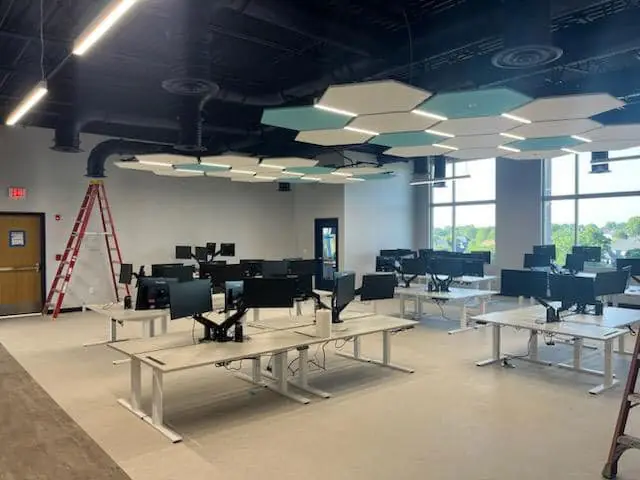
The project gallery on Craine’s website shows how wide commercial work runs: a retail floor under a grid of troffer lights, an open office with acoustic ceiling panels and a ladder still standing in it, a church sanctuary under a wood-plank ceiling, an auditorium, a rooftop patio at dusk, and a round common room with a circular tray ceiling. Each of those has a different lighting problem, and a plan that treats them all the same will miss.
Customers say the same about the process. A customer on their website, Tami Artt Scoggins, wrote that they “took care of our store in a timely and professional way.” On Google, Josh Bryant wrote that he has used Craine’s “for commercial and residential projects for over a decade,” and that “they make it right and want what’s best for the customer and end user.”
Justin Cullers, a builder, also listed commercial finish-outs among the work Craine’s has been a part of for him.
Starting the conversation
The best time to call is when you have a lease or a set of plans and a date, even if the details are still loose. We can look at what you have, flag what will take the longest, and tell you what we need from you and when.
Craine’s handles ground-up construction wiring and dependable repairs for businesses across Northwest Arkansas and Southern Missouri. Call (479) 750-1672 in Northwest Arkansas or (417) 952-0828 in Southern Missouri, Monday to Thursday, 8 to 5, and we will give you a free, fair and honest quote with no strings attached.
Craine's Electric & Drywall, (479) 750-1672
Call (479) 750-1672More articles
Why a breaker keeps tripping, and when to call an electrician
A tripped breaker is the protection working, so the real question is what it had to protect you from.
Wiring and drywall from one company: what it changes on a new build
The wall is a handoff between two trades, and every handoff is a place where days go missing.